Endian matters, linker libraries and constructors.

The EightThirty Two ISA – Part 20 – 2020-04-03

I’m continuing to make gradual improvements to the EightThirtyTwo toolchain, and over the last few days I’ve given my attention to linker libraries, and endian issues.

While I initially intended EightThirtyTwo to be a big endian CPU, it occurred to me early on that I could make endian-ness configurable with a generic parameter. This I did, and having set that “littleendian” parameter to “true” for testing, I never actually changed it back, so all my testing over the last few months has actually been in little endian mode!

Continue reading

A minimal OSD component

Porting an arcade core to the Turbo Chameleon 64 – Part 2 – 2020-03-06

For the Chameleon64 port of Rampage I needed some way of showing an On-Screen Display. While the core doesn’t have many options to worry about, I did want to be able to display a “Loading” message and an “Error” message if loading the ROM failed.

There are several different ways we could approach this, but as you’ll recall from part 1, we’re very short of block RAM for this project, so minimising block RAM usage will be my priority.

Continue reading

When is a UART not a UART?

Tunneling debugging information over JTAG – 2020-03-04

One of my primary platforms for FPGA tinkering is the Turbo Chameleon 64 cartridge – which comes in two flavours: the original V1 hardware which features a Cyclone III FPGA and the V2 hardware which has a very similar Cyclone 10LP FPGA (basically the same thing in a newer package).

While this cartridge is intended as an expansion for the venerable Commodore 64 8-bit computer from the 1980s, it can nonetheless run other more general-purpose cores, so most of my projects have Chameleon64 targets. The one downside of this hardware is the lack of general purpose IOs. It has no built-in serial port, and nowhere really convenient to attach a USB-serial dongle either. It’s possible to misuse the IEC port for this purpose, but then I need to remember to disable it before distributing a finished core (I doubt a 1541 disk drive would appreciate having RS232 data spewed at it). There’s also a USB debugging protocol built into the cartridge, which I haven’t yet explored – mostly because so many of my projects can be built for multiple platforms, I’m reluctant to put a large amount of effort into supporting features only available on one of them.

I discovered the other day, however, that it’s possible to tunnel a UART-style connection over JTAG.

Continue reading

On the Rampage…

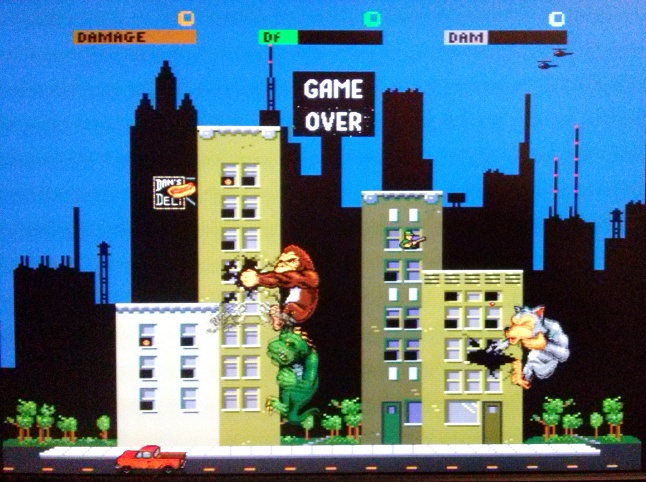
Porting an arcade core to the Turbo Chameleon 64 – Part 1 – 2020-02-26

There are many, many arcade re-creation cores in existence now – and only a handful have been ported to the Turbo Chameleon 64. When I discovered that Rampage exists for both MiSTer and MiST my interest was piqued, because this is a game I played on the Amiga as a kid, and while the Amiga version’s not a bad conversion, the original arcade game is significantly better.

Continue reading

Mitigating Hazards

The EightThirtyTwo ISA – Part 17 – 2020-02-16

I was looking today at ways of improving the throughput of the EightThirtyTwo CPU. The design as it stands is very simple, and didn’t make any attempt to perform result forwarding or instruction fusing. These are both strategies for improving the performance of certain constructs, and I wasn’t sure which of these two techniques I should use.

In brief, without either mechanism implemented, when the CPU encounters code such as:

    li 0
mr r0

it has to wait until the first instruction has finished writing to the tmp register before moving its new contents into the pipeline, and only then finally writing it to r0.

Continue reading